
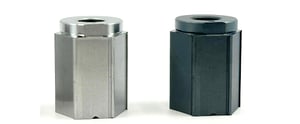
Steam treating usually comes up after sintering, once surface performance starts to matter. The part already has its strength. The next question is how it’s going to hold up in the real world. At that point, the foundation is already there. The next question is how that surface is going to perform once a part is in service.. That’s usually where surface treatments come into play. .
On the surface, the process sounds simple. Sintered parts are reheated and exposed to steam. The result is a darker finish and a more stable surface. However, what’s happening at the material level is not always obvious.
In Episode 13 of the PM Blend podcast, the Atlas team sits down with Abbott Furnace Company to talk through steam treating and what it does to the part. They also get into when it makes sense to use and how it fits into production.
What is Steam Treating in Powder Metallurgy?
Steam treating is a secondary step that takes place after sintering. It is used to modify surface properties without changing the core structure of the part.
At this point, the questions tend to shift from strength to performance:
- Will the part resist wear?
- Will it handle exposure to open air or moisture?
- Will surface behavior stay consistent over time?
The process reheats the part and introduces steam in a controlled furnace. As the temperature rises, the surface becomes more receptive to that reaction.
As Brian from Abbott Furnace explains, “The steam penetrates through the porosity of the product and forms an oxide layer.”
That reaction forms a thin oxide layer on the surface. It is known as magnetite, or Fe₃O₄.
Rather than sitting on top like a coating, this layer forms through a chemical reaction with the base material. This is where the performance changes come from.
How the Steam Treating Process Works
The process starts with a sintered part. From there, parts are reintroduced into a furnace for secondary processing
There are two common setups.
- Continuous belt furnace
Parts move through on a belt. They heat up first, then pass through a steam zone where the reaction takes place. Cooling happens at the end of the line.
- Batch system
Parts are loaded into a sealed vessel. The chamber is heated, purged, and then introduced to steam under controlled conditions. Once the cycle is complete, parts are removed and cooled.
In both cases, process control is critical. Temperature, dwell time, and steam quality directly influence oxide formation. Even small deviations can show up quickly in surface appearance or performance.
Surface color is often the first indicator that something has drifted out of spec.
Why Steam Streating Gets Spec'd
Steam treating is usually specified when surface-related issues appear during use - not when parts lack strength. Common drivers include exposure to air or outdoor conditions, repeated contact, or a need for better paint or adhesive performance.
The process addresses those problems in a few ways:
- Slows down surface corrosion
- Improves wear through a harder outer layer
- Seals surface porosity
That last point carries weight. Once the surface is sealed, paint sits better and adhesives behave more consistently.
As Joe from Atlas puts it, “It’s a relatively inexpensive process… a very economical way to get that darker finish.”
What Changes in the Part?
Steam treating affects the outer surface of the part. The internal microstructure stays the same.
You’ll see a darker finish. Most parts take on a blue or black tone, and the surface becomes more uniform.
This change occurs at the outer layer of the part. The oxide forms within surface-level porosity, creating a more consistent structure across the exterior. That helps reduce variation when parts are exposed to wear or environmental conditions.
There is a small dimensional shift. The oxide layer adds material to the surface,typicallymeasured in microns.
In use, that translates to:
- Better wear resistance
- Slower corrosion in open environments
Where It Makes Sense
Steam treating works best when surface performance is the primary concern.
It is often selected when parts are exposed to the environment or when a more stable surface is needed without adding a separate coating process.
It is commonly used for:
- Outdoor components
- Lawn and garden applications
- Parts with light wear conditions
- Applications where a darker finish is preferred
It may not be the right fit when heavy corrosion protection is required or when another coating is already specified.
Bringing Steam Treating into Focus
Steam treating comes into the picture when surface performance starts to fall short. The part is already made. Now it has to hold up once it leaves the shop.
It creates a harder outer layer. It slows down corrosion. That helps parts perform more consistently over time.
If you prefer to listen to this kind of information on the go, Episode 13 of the PM Blend podcast walks through how this shows up in production and where it fits, with insight from the Atlas team and Abbott Furnace Company.
Prefer Reading Over Listening?
If you want more breakdowns like this, the blog library covers a range of powder metal topics in a similar format.

COMMENTS