
.png?width=300&name=Webpage%20Headers%20(8).png)
Powder Metallurgy Design Tips

Effective powder metallurgy (PM) design depends on understanding how specific features behave during compaction and sintering. The points below highlight the design elements that most often influence manufacturability and part consistency.

Holes
Holes formed in the pressing direction may be round, D-shaped, keyed, or splined. These features rely on core rods that must remain stable during compaction and ejection to maintain dimensional accuracy.- Lightening holes can help lower the projected pressing area on larger parts.
- Side holes must be added after sintering through a machining operation.
Wall Thickness
Wall thickness influences powder flow and die fill, which are important design factors in powder metallurgy. As a general guideline, avoid walls thinner than 0.060 inch (1.52 mm) to help maintain consistency during production.
- Long, narrow walls may lead to density variation.
- Thin sections can place added stress on the tooling.
Flatness
Flatness depends on part geometry and section thickness in powder metallurgy. Thinner parts are more likely to distort during sintering or heat treatment.
- Repressing can help improve flatness when needed.
- Projection bosses are often easier to level than full face surfaces.
Fillets and Radii
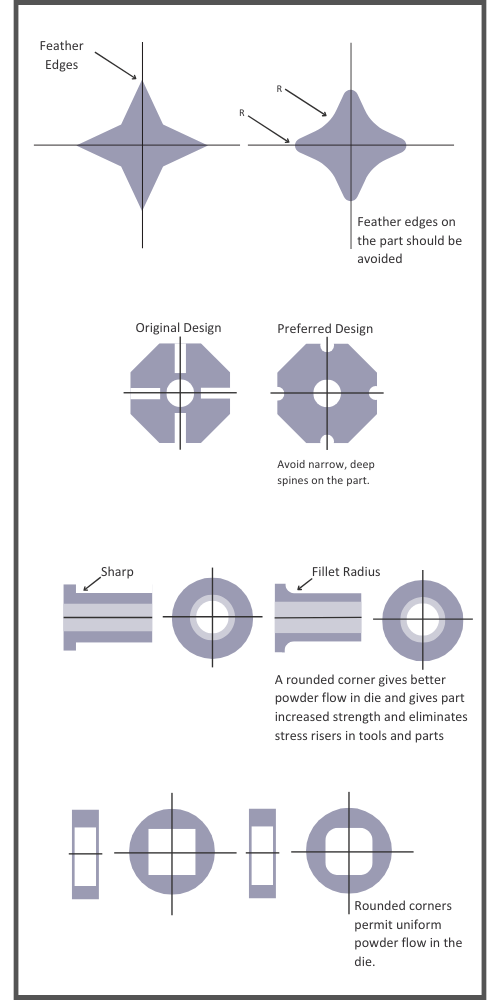
Fillets and radii support better material flow during compaction and reduce stress on tooling. Generous radii also help improve strength in powder metal parts by minimizing sharp transitions that can concentrate load.
- Larger fillets generally lead to longer tool life and more consistent part quality
Tapers and Drafts
Draft is generally not required in powder metallurgy because parts are compacted and ejected in a straight direction. In some cases, a slight draft on outer surfaces can help with ejection, but it must be applied carefully to avoid slowing the production process.
- Excessive draft can affect timing between tools.
- Steeper angles may reduce production rates.
.png "500 X 1000 Website Images (1)")
Chamfers and Bevels
Chamfers help prevent burring on edges, especially on bushings or parts with sharp transitions. A small flat – typically 0.005 to 0.015 inch (0.13 to 0.38 mm) – is preferred to avoid fragile edges.
- Larger chamfers can be formed with die or core rod geometry but may slow production.
Countersinks
Countersinks allow screw or bolt heads to sit within the part. When formed by a punch, a small flat of about 0.010 inch (0.25 mm) helps maintain punch durability.Flanges
Flanges and steps can be formed directly in the die if the geometry is modest. More substantial overhangs create ejection challenges and may require generous radii at the transitions.- Large flanges are more likely to stick in the die.
- Smaller steps typically form cleanly without secondary work.
Bosses
Bosses are formed using cavities in punch tools. Their depth and shape influence ejection behavior and should be designed with release in mind.
- Draft angles of 7° to 15° help the boss release cleanly.
Undercuts
Undercuts on horizontal surfaces cannot be produced in the die because they prevent straight ejection. When needed, these features are added after sintering.
- Annular grooves and corner reliefs often require machining.
.png?width=300&name=Webpage%20Background%20(4).png)
Need Help with a Powder Metal Solution?
Speak with an Atlas Expert Today!

Need a Solution?
Ask Us a Question
Contact Information
Mailing Address
125 Tom Mix Dr.
P.O. Box P
DuBois, PA 15801
USA
Phone
Fax
Testimonial
"Our Engineering team works directly with Atlas Pressed Metals to achieve our company goals. Atlas is always very helpful, gives us on-time delivery and the sales reps are always willing to research to get answers for our needs.”
- Amanda S., Associate Buyer | Healthcare Industry