
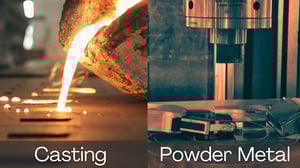
Casting vs powder metallurgy is often compared as designs move closer to production. Both processes are used to produce durable metal parts, but they rely on different forming methods.
Casting uses molten metal and molds, while powder metallurgy forms parts through compaction and sintering. That distinction shapes how parts behave once production moves beyond initial runs.
This article looks at casting vs powder metallurgy from a production perspective, focusing on how each process behaves once designs move into sustained manufacturing.
Die Casting vs Powder Metal: What's the Difference?
Die casting and powder metallurgy are both established metal forming methods. Each shapes parts in a different way, which influences how they behave in production.
Those differences begin at the point of formation and carry through the rest of the process.
Die Casting
Die casting produces parts by injecting molten metal into a hardened steel mold under high pressure. The metal cools and solidifies inside the cavity before the part is ejected and finished.
- The process depends on heat and controlled cooling to create the final shape
- Tooling is built to withstand repeated thermal cycles during production
- Cooling rates and solidification patterns influence dimensional results
- Secondary steps such as trimming or machining are often part of the workflow
Die casting is commonly used for high-volume production and parts with detailed external geometry, including thin walls and smooth surfaces.
Powder Metallurgy
Powder metallurgy forms parts by compacting metal powders into compacts, then sintering them in a controlled environment, allowing the particles to bond. This approach shapes material properties and consistency in ways that differ from casting.
- Parts are formed without melting the metal
- Density and material structure are established during compaction and sintering
- Dimensional accuracy is largely determined by tooling
- Many parts come out near net shape, reducing or eliminating the need for secondary operations
The PM process provides greater control over material behavior and part-to-part consistency, helping maintain uniform quality throughout production.
Die Casting vs Powder Metal: How Do Cost and Efficiency Compare?
Cost and efficiency differences between die casting and powder metallurgy often become clearer once production is underway. Factors tied to tooling behavior, production flow, material use, and cycle times tend to shape how costs and throughput develop as volumes increase.
Looking at these elements together provides a clearer picture of how each process performs beyond the initial quote - not just in terms of expense, but also in how efficiently parts can be produced at scale.
|
Factor |
Die Casting |
Powder Metallurgy |
|
Tooling life |
Subject to thermal cycling and wear over long runs |
Typically mechanical and often supports full project lifecycle |
|
Tool maintenance |
May require refurbishment or replacement |
Generally limited when tooling is properly designed |
|
Production flow |
Includes cooling, ejection, and trimming steps |
Driven by press speed and sintering cycles |
|
Secondary operations |
Trimming or machining is common |
Many parts produced near net shape |
|
Material utilization |
Gates and runners generate excess material |
Most material becomes part of the finished part |
|
Scrap generation |
Scrap can increase during trimming and rework |
Scrap is typically limited during forming |
Die Casting vs Powder Metal: How Do Material Choices Affect Part Design?
Material behavior and part design are closely connected once a component moves into production. The way metal is formed influences internal structure, achievable geometry, and how consistently features can be produced at scale.
Considering material characteristics and design factors together helps clarify how each process supports different part requirements.
|
Factor |
Die Casting |
Powder Metallurgy |
|
Material density |
Typically near full density |
Can be controlled through compaction and sintering |
|
Internal structure |
Influenced by cooling and solidification |
Formed through bonding and alloying powder particles |
|
Strength consistency |
Can vary with solidification behavior |
Generally uniform across production runs |
|
Alloy flexibility |
Wide range of castable alloys |
Allows engineered blends tailored to application |
|
Geometry complexity |
Supports complex external shapes but requires draft angles for release |
Complex geometries shaped by tooling and press direction but draft angles are discouraged |
|
Internal features |
Often require cores or secondary operations |
Can typically be formed during compaction |
Die Casting vs Powder Metal: What Affects Long-Term Part Consistency?
Consistency and quality tend to show up over time rather than at the start of production. As tooling ages and production runs extend, the way a process holds tolerance and maintains part-to-part stability becomes more apparent.
Looking at dimensional control and long-term stability together helps clarify how reliably each process performs as production scales.
|
Factor |
Die Casting |
Powder Metallurgy |
|
Dimensional control |
Influenced by cooling and solidification behavior |
Largely defined by tooling and compaction |
|
Tolerance consistency |
Can vary across extended production runs |
Generally stable once parameters are set |
|
Surface finish |
Smooth surfaces achievable out of the mold |
Uniform finish from tooling and powder size |
|
Part-to-part variation |
Dependent on mold condition and process control and cavity to cavity variation |
Typically uniform across production |
|
Long-run stability |
Influenced by tooling wear and thermal effects |
Often steady over extended production |
Choosing the Right Process for the Job
Casting vs powder metallurgy is rarely a theoretical decision. It usually comes into focus once production realities start to shape expectations and tradeoffs become clearer.
Looking at how each process behaves over time makes those tradeoffs easier to evaluate. When cost, consistency, material behavior, and design needs are considered together, the right choice tends to surface without guesswork or course correction later on.
More on Powder Metallurgy
Find more articles that look at manufacturing processes through a practical, production-focused lens.

COMMENTS