
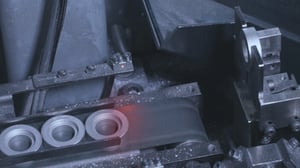
In Episode 10 of The PM Blend, the Atlas team takes a closer look at machinability – what it is, why it matters in powder metallurgy, and how machining supports the final performance and precision of PM parts. While PM is known for near-net-shape capabilities, machining still plays a key role in finishing certain features and meeting tighter requirements.
Below is an article version of the conversation, closely following the insights shared by Mark Powell, Joe Pfingstler, Dom Bevak, Tom Pfingstler, and Rob Powell.
What Is Machinability?
Machinability refers to how easily a material can be machined. As Dom explains, several factors influence machinability in PM:
- The material system (such as iron-nickel or iron-copper)
- The hardness of the material
- Porosity, which is unique to powder metal and directly affects how a part behaves during machining
All of these determine how a tool engages with the material and which cutting conditions are needed.
Why Machining Is Still Relevant in PM
Even though PM aims to create parts that are as close to the final shape as possible, some features simply can’t be molded in.
Machining becomes necessary when parts require design features and enhancements like:
- OD grooves or threads
- Cross holes or tapped holes
- Face details
- Surface finish improvements
- Tighter tolerances than the molding process can hold
Some features also cannot be formed because the part cannot be ejected cleanly from the mold, or because thin tooling sections would be too weak.
Machining fills these gaps and ensures that PM parts meet the exact requirements needed for the application.
Common Features That Require Machining
As the team outlines, machining may be used for:
- OD grinding
- Double-disc grinding
- Turning
- Threads
- Cross holes
- ID and OD grooves
- Tight-tolerance internal diameters
- Low surface finish requirements
- Centerless grinding
The type of machining performed depends on the feature, the tolerance, and how the part was molded.
Material and Microstructure Considerations
Tom and Rob note that material behavior plays an important role in machinability. Factors include:
- The microstructure, which affects tool performance
- If the part has been sinter-hardened or heat-treated
- When machining occurs in the workflow (pre- or post-heat treat)
Resin impregnation may also be used in certain cases to support machining needs, depending on how the part has been processed.
Some raw materials also include machining additives that improve machinability, which the materials team evaluates based on the part and performance requirements.
Choosing the Right Cutting Tools
Dom explains that tool selection is primarily driven by the material being machined.
Atlas commonly uses:
- Carbide tools
- CBN tools (especially for harder materials)
- High-speed steel taps
- Coolant as needed, depending on the part and geometry
Both the tool geometry and the feature being produced play significant roles in determining the setup.
Example: Heavy-Duty Truck Components Converted to PM

During the episode, the team highlights two components used in heavy-duty truck applications.
To create the parts, Atlas first created PM blanks that allowed the team to handle the remaining details through machining:
- Turning a hub section that could not be molded due to the tooling thickness limits
- Bringing an internal diameter into a tight tolerance needed for bearing installation
- Adding drilled and tapped holes
- Machining an OD groove
- Achieving a low surface finish requirement, the molding/sintering process could not hold
In one component, the teeth had to be molded to full height. Machining then reduced a thin top section to its final dimension since forming the teeth only partway up the wall would have made the tooling too thin.
This combination of molding and machining allowed Atlas to deliver the required strength, consistency, and cost savings.
Emerging Trends in PM Machining
As Dom shares, tooling vendors continue advancing their solutions with:
- New tooling grades
- New geometries
- Improvements that lead to longer tool life
Atlas works closely with vendors to match tool selection to each part’s material and machining requirements.
The Role of Fixturing
Fixturing is another essential part of machining PM components. Dom and the tooling department design most fixtures in-house, with around 80% produced internally. Fixture design depends on the geometry, the machine, and what features need to be accessed.
How Atlas Stays Ahead on Machinability
The team highlighted several ways they continue improving machining outcomes:
- Staying up to date on raw materials and how they affect machinability
- Participating in industry conferences, committees, and MPIF resources
- Listening closely to customer machining feedback
- Evaluating machinability early during quoting to determine what is feasible
- Working creatively to support PM conversions, even on parts with challenging geometries
As Joe notes, Atlas aims to help customers make their components more effective and competitive, not simply reject complex parts.
Final Thoughts
Machinability is an essential part of powder metallurgy. While PM brings the advantage of forming complex shapes efficiently, machining ensures that final parts meet the exact tolerances, fit, and function required.
When machining and PM work together, manufacturers benefit from consistent performance, reliable assembly, and substantial cost savings, especially for parts that were previously machined or cast.

COMMENTS