
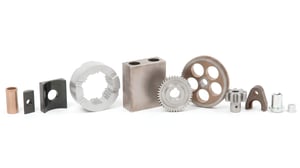
Powder metallurgy is often associated with small metal components. While the process is well suited for compact parts, its manufacturing capabilities extend to much larger designs.
But how small can a powder metal part be before manufacturing becomes difficult? And what happens when a component gets too large for conventional pressing equipment?
The answer depends on the design itself. A component's dimensions don't always indicate how difficult it will be to manufacture.
In Episode 18 of The PM Blend, the Atlas Pressed Metals team discusses powder metal part size and how press capabilities influence component manufacturing.
How Small Can Powder Metal Parts Be?
Some powder metal components are small enough to fit inside the tip of a pen.
Atlas has manufactured components at this scale, including extremely small parts that required additional evaluation before production could begin.
The main challenge with small components is getting powder into the tooling.
Thin Walls and Powder Flow
Powder must be able to flow into the die cavity during filling. When a component has extremely thin walls, there may not be enough space for the powder to fill those features consistently.
Part length can make this more difficult. A long, narrow feature may be harder to fill than a shorter feature with the same wall thickness.
Tooling Support for Small Components
Small parts can also present challenges during compaction.
Thin tooling members must withstand pressing forces without excessive deflection. This becomes particularly important when producing high-density components.
In some cases, even a very small component may require a larger press to accommodate the equipment needed to remove it after compaction.
How Large Can Powder Metal Components Get?
Powder metallurgy can produce components considerably larger than the small bearings and mechanical parts often associated with the process.
Atlas has equipment capable of manufacturing larger powder metal components, although the practical limits depend on the design.
During the episode, the team discusses several examples of these capabilities:
- Press capacity: Atlas's largest press is 825 tons.
- Component diameter: Potential capabilities extend to 8–10 inches, depending on part geometry.
- Component weight: Parts weighing up to 15 pounds may be possible under suitable conditions.
- Production examples: Atlas has manufactured components approximately 5 inches in diameter, weighing around 3 pounds before machining.
These figures represent different manufacturing scenarios. Atlas does not currently produce a 15-pound component, but the equipment provides opportunities for larger designs.
What Determines Powder Metal Part Size?
A component's outside diameter doesn't tell the full story of its manufacturing requirements.
During powder pressing, the amount of force required depends heavily on the projected pressing area being compacted. A larger component with a substantial opening through its center may require less pressing force than a solid component of similar diameter.
Several design considerations influence manufacturing feasibility, making an engineering drawing design review an important step before production.
|
Consideration |
Effect on manufacturing |
|
Press tonnage |
Limits the available compaction force |
|
Cross-sectional area |
Influences the force needed to compact the powder |
|
Affects pressing force requirements |
|
|
Die dimensions |
Must fit within the available press space |
|
Component complexity |
May require additional tooling levels |
|
Part extraction |
Requires sufficient room for removal equipment |
Press selection isn't always determined by tonnage alone.
A component may require relatively little compaction force but still need a larger press to accommodate its tooling. Complex designs with multiple levels can create additional space requirements within the press.
How Does Component Size Affect Powder Metal Tooling?
Powder metal tooling must maintain dimensional control throughout compaction. As component size changes, different engineering challenges become more noticeable.
Tooling Deflection During Compaction
Larger components can place substantial forces on tooling members.
When the press releases pressure, those tooling members return toward their original positions. If different sections recover unevenly, the resulting stress can cause cracks in the compacted part.
This concern isn't limited to large components. Small parts with thin walls can experience similar problems, particularly when high compaction densities are required.
Dimensional Changes During Sintering
Powder metal components undergo dimensional changes during sintering. Depending on the material, a part may grow or shrink as it passes through the furnace.
The effect becomes more significant as component dimensions increase.
A small percentage of dimensional change may have little effect on a half-inch component. That same percentage produces a much larger dimensional difference on a five-inch component.
Accurate predictions of material behavior help manufacturers develop tooling that produces the required finished dimensions.
Where Are Different Powder Metal Part Sizes Used?
Powder metal components are used across industries with very different size requirements.
The final application often determines the size of the component.
Examples discussed in Episode 18 include:
- Electric motors: Small bearings used in fractional-horsepower motors
- Appliances: Compact components used in mechanical assemblies
- Automotive: Larger transmission gears and carrier components
- Industrial equipment: Components designed for heavier mechanical loads
- Locomotives: Small parts used in control mechanisms
Even large equipment can contain relatively small powder metal components. The part's function within the assembly matters more than the overall size of the equipment.
When Should Manufacturers Consider Powder Metallurgy?
Powder metallurgy is one manufacturing option for engineers evaluating a new component.
The process becomes particularly attractive when an existing design requires substantial machining to reach its finished shape.
Near-net-shape production can offer several advantages:
- Less material waste: Reduces the amount of material removed during manufacturing.
- Fewer machining operations: Forms many features during compaction.
- Design flexibility: Allows engineers to reconsider component geometry for PM production.
Not every component is a good candidate for powder metallurgy.
A casting that already meets its dimensional requirements may be the better choice. The same applies to a machined component requiring only minimal material removal.
Atlas works with customers to evaluate how a component functions within its assembly. That discussion can identify opportunities for design for cost reduction while maintaining the component's intended performance.
Powder Metal Part Size Starts With the Right Design
There is no single minimum or maximum powder metal part size that applies to every component.
The practical limits depend on the design and the manufacturing equipment available. As discussed in Episode 18 of The PM Blend, even components at opposite ends of the size spectrum can present similar engineering challenges.
Evaluating the design early can help determine if powder metallurgy is a suitable manufacturing method.
Have a Powder Metal Component in Mind?
Considering powder metallurgy for an existing component or new design? Contact the Atlas team to discuss your application and manufacturing requirements.

COMMENTS