
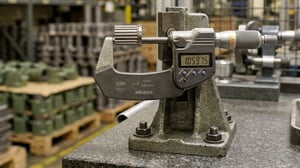
When you're designing a new component, tolerance requirements can influence many of the decisions that follow. In some cases, they even determine whether powder metallurgy remains under consideration before tooling is even discussed.
If you're considering powder metallurgy, understanding what the process can realistically achieve helps you evaluate it alongside other manufacturing methods. Having accurate information early in the design process makes it easier to compare manufacturing options and make informed decisions.
Powder metallurgy tolerances are established throughout the manufacturing process. Design decisions and production methods both influence the final dimensions.
Understanding where those tolerances come from gives you a better foundation for evaluating powder metallurgy and making design decisions with confidence.
Can Powder Metallurgy Meet Tight Tolerance Requirements?
Yes, but there isn't a single answer for every part.
Powder metallurgy can produce parts with tight dimensional control. Many parts meet required tolerances once sintered. For features requiring additional precision, secondary operations can further refine dimensional accuracy.
The tolerances a powder metal part can achieve depend on several aspects of the manufacturing process.
- Pressing direction
- Part geometry
- Material selection
- Sintering
- Secondary operations, when needed
What Affects Powder Metallurgy Tolerances?
Tolerance capability begins long before a finished part leaves the sintering furnace. Every step of the powder metallurgy process influences the final dimensions, which is why two parts can require different manufacturing approaches even when their tolerance requirements appear similar.
Pressing Direction
Pressing direction has one of the biggest influences on powder metallurgy tolerances. Because metal powder is compacted in a single direction, some dimensions are easier to control than others.
Dimensions measured perpendicular to the pressing direction are typically easier to maintain because the die supports the powder during compaction. Dimensions measured parallel to the pressing direction rely more heavily on the compaction process, which can lead to greater variation.
That's one reason pressing direction should be considered early in the design phase. In many cases, a small design adjustment can improve dimensional control while minimizing the need for additional processing.
Part Geometry
The shape of the component also influences dimensional accuracy. Features such as thin walls, sharp transitions, and complex geometries can affect how powder fills the die and compacts before sintering.
Designing with the manufacturing process in mind often produces more consistent results. If you're evaluating a new component, reviewing the geometry before tooling is built can help identify opportunities to simplify production while supporting the required tolerances.
Material Selection
Different powder metal materials respond differently during sintering. Material composition influences how the part responds to heat and the dimensional changes that occur during processing.
Those changes are predictable, but they still need to be considered during the design stage. Selecting the right material helps establish realistic tolerance expectations before production begins.
Sintering
A powder metal part doesn't reach its final dimensions when it leaves the compaction press. During sintering, the metal particles bond together, and the part experiences controlled dimensional change.
Manufacturers account for this behavior when designing tooling and developing the manufacturing process. Understanding how a material responds during sintering helps produce consistent dimensions throughout production.
When Do Powder Metal Parts Need Secondary Operations?
Many powder metal parts leave the sintering furnace ready for production. Others require additional refinement on specific features to meet application requirements.
When tighter tolerances are required, secondary operations allow manufacturers to refine specific features after sintering.
Some of the most common secondary operations include:
- Sizing: Represses the sintered part in a precision die to improve dimensional accuracy and consistency.
- Coining: Refines selected features while improving surface finish and part density.
- Machining: Produces tighter tolerances on features that cannot be formed or controlled during compaction.
- Grinding: Used when a surface requires an exceptionally high level of dimensional accuracy or finish.
Not every part requires these additional steps. In many applications, they are only used where the function of the component calls for tighter dimensional control.
Should Every Feature Have a Tight Tolerance?
It's easy to assume that tighter tolerances always produce a better part. In reality, the most effective designs apply tighter tolerances only where they add functional value. Every tolerance on a drawing has a purpose, and not every feature influences how the finished component performs.
Before tightening a tolerance, think about what that dimension needs to accomplish.
|
Design Situation |
Recommended Approach |
|
A feature affects part performance |
A tighter tolerance may be appropriate. |
|
A feature has little effect on performance |
A standard as-sintered tolerance may be sufficient. |
|
One dimension requires greater precision |
A secondary operation may be the most practical solution. |
|
Multiple features require tighter control |
Review the manufacturing process before finalizing the design. |
Matching the tolerance to the function of the feature helps control manufacturing costs and keeps additional processing focused where it provides the greatest benefit.
Why Discuss Tolerances Before Tooling is Built?
The earlier tolerance requirements are reviewed, the more opportunities there are to optimize the design before tooling is built.
That's one reason tolerance discussions happen so early in the design process. Before production begins, there's still time to decide which dimensions need closer control and where standard powder metallurgy tolerances will work just fine.
Those conversations often answer questions like:
- Can this feature meet the required tolerance as-sintered?
- Would sizing achieve the required result?
- Is machining necessary, or would a design change accomplish the same thing?
- Does this tolerance affect how the part functions?
Taking the time to answer those questions early can prevent design revisions later and help establish a clear path into production.
Powder Metallurgy Tolerances Start with Design
Every powder metal part starts with a series of design decisions. Those decisions influence what the manufacturing process can achieve and how the part moves into production.
Evaluating tolerance requirements early helps establish realistic design expectations before tooling begins. With that understanding, engineers can make informed manufacturing decisions and determine whether powder metallurgy is the right fit for the application.
Looking for More Design Guidance?
Our PM Design Guide takes a closer look at the design principles behind successful powder metallurgy projects. Download your copy to learn how thoughtful design choices can support manufacturability from the start.

COMMENTS