
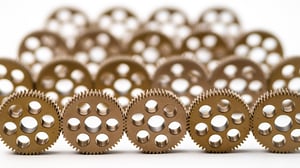
Gears are used in everything from automotive systems to household appliances. While the basic function stays the same, the manufacturing method behind a gear can influence how it performs and what it costs to produce.
Powder metallurgy has been used for gear production for decades. Advances in materials and manufacturing equipment have expanded what is possible through the PM process and opened the door to more demanding applications.
In Episode 15 of The PM Blend, our team spent some time talking about gear engineering and the manufacturing decisions behind it. Those decisions often start long before a gear reaches production.
What Changes During Gear Engineering for Powder Metal Gears?
Many of the same engineering principles apply to both powder metal and machined gears. Engineers still need to consider the application, gear form, and how the component will function within the assembly.
The biggest differences often come from the manufacturing process itself. Powder metallurgy can accommodate multi-level designs and features that may require additional operations in other manufacturing methods.
There can also be some PM-specific design considerations. During the podcast, the team discussed tooth tip and root radii as one example. Small adjustments like these can help support the tooling used to produce the gear.
How Do Powder Metal Gears Compared to Machined Gears?
One of the biggest questions surrounding powder metal gears is performance. When a gear is going into a demanding application, it has to perform reliably under load and in real-world conditions.
During the podcast, the conversation touched on several factors that are often evaluated during gear engineering:
- Strength
- Hardness
- Fatigue resistance
- Dimensional consistency
- Surface finish
Powder metal gears are used in many demanding applications, including automotive transmissions and transfer cases. When designed correctly, they can achieve performance levels comparable to machined gears.
Because the tooling remains the same throughout production, powder metal gears can maintain tight dimensional control across large production volumes.
Why Are Powder Metal Gears Often More Cost-Effective?
Cost is one of the main reasons manufacturers take a closer look at powder metallurgy. Much of that comes back to how the part is produced.
Several factors can contribute to lower production costs:
- Near-net-shape production
- Less machining
- Reduced material waste
- Faster production cycles
The gear teeth are formed during the compaction process rather than cut from a piece of steel. That eliminates machining operations that can add both time and cost to production.
The way each process uses material is very different. A machined gear requires material to be removed to create the final shape. Powder metallurgy uses the material placed into the tooling to form the component, which results in far less scrap.
How Are New Technologies Expanding PM Gear Capabilities?
Powder metallurgy has changed significantly over the years. Improvements in equipment and materials have expanded what manufacturers can accomplish with PM gears.
Many of the limitations associated with older PM processes have been reduced through advancements in technology, allowing engineers to consider powder metal gears for a broader range of applications.
|
Advancement |
Impact on PM Gears |
|
CNC-controlled presses |
Greater control during compaction and support for more complex geometries |
|
Higher material densities |
|
|
Improved material consistency |
More predictable production results |
|
Sinter-hardening |
Reduced reliance on some secondary heat-treat operations |
Together, these advancements have increased design flexibility and expanded the range of applications that can benefit from powder metallurgy.
What Industries Use Powder Metal Gears?
Powder metal gears are used in a wide range of products and systems. During the discussion, the team pointed to applications such as:
- Automotive: transmissions and transfer cases
- Lawn and garden: drive systems and gear assemblies
- Appliances: gear-driven household equipment
- Medical devices: precision mechanical components
- Industrial equipment: gearboxes and electric motors
The list covers a broad range of industries, each with its own performance requirements and production demands. Some applications prioritize durability, while others focus on production volume or dimensional consistency.
Powder metal gears continue to find their way into new applications as PM capabilities expand. As materials and manufacturing technology have advanced, powder metal gears have become a practical option for an increasingly diverse set of applications.
Gear Engineering Starts With the Right Manufacturing Method
A successful gear design is shaped by decisions made long before production begins. The manufacturing method selected can influence the direction of the entire project.
As discussed in Episode 15 of The PM Blend, advances in powder metallurgy have expanded the range of applications where PM gears can be considered. For engineers evaluating gear engineering options, that can open the door to new possibilities during the design process.
Ready to Discuss Your Gear Design?
Evaluating a new gear design? We're here to help you assess your options and identify the best path forward.

COMMENTS