
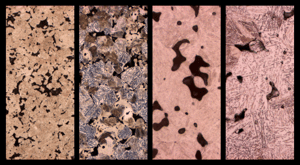
What if you could control powder metal density before a part was ever manufactured?
Powder metal density isn't fixed by chance. It can be influenced throughout the manufacturing process, giving engineers the ability to target the material properties an application requires instead of accepting a one-size-fits-all result.That flexibility is one of powder metallurgy's greatest advantages. By understanding what affects density and how it can be adjusted, manufacturers can produce components that meet performance goals while supporting efficient, repeatable production.
What Is Powder Metal Density?
PM components consist of metal powder blends, compacted and sintered to achieve a final shape. The final density of a powder metal part depends on:
- Design
- Material properties
- Material compressibility
- Processing methods
- Secondary operations
Powder metal density refers to the mass per unit volume of a material. The typical density ranges for conventional die pressing and sintering applications are:
|
Structural Parts |
Bearings |
|
|
Density |
85% - 93% |
75% - 87% |
|
Theoretical |
6.6 g/cm3 |
5.8 g/cm3 |
Wrought steel operations (stamping, machining, and forging) yield a density of 100%, or approximately 7.8g/cm3 theoretical density. While some applications require wrought steel components, others have more material flexibility.
If it’s possible to convert your part to powder metal, you might get a more economical result with improved characteristics and performance.

How to Increase Powder Metal Density
Increasing powder metal density starts with understanding the options available. There are several strategies for improving strength and other properties via density:
Optimize Your Part Design
An optimized powder metal design ensures both performance and manufacturability. Areas of your design that can impact density in powder metallurgy include:
- Shape: Adjusting the geometry in specific areas can lead to more effective compaction
- Size: For example, thicker sections can be designed to reduce voids
- Distribution of materials: Strategic placement, i.e. using powders of varying particle sizes or shapes that pack more densely
- Other part characteristics
Consider using these features, possibly in tandem with differential compaction and localized sintering, to increase density in specific locations on the component.
Tweak Your Material
Choosing the right material mix for your application can produce higher-density components. Let’s look at a few different powder mixes that might be relevant to your work.
- Copper-alloyed steels (FC) often contain small amounts of copper and carbon, which create strong alloys at a reasonable price. The iron-copper family of alloys can yield densities up to 90% (7.1 g/cm3) with conventional press-and-sinter processing.
- Iron-nickel (FN), diffusion-alloyed (FD), and pre-alloyed (FL) materials can be pressed from 90% dense (7.0 g/cm3) up to 93% dense (7.3 g/cm3) using conventional pressing methods.
Try Warm Die Compaction
In a normal powder metallurgy tool compaction cycle, the operator feeds raw material into a die design, after which the compaction tool presses it into a “green” compact. In powder metallurgy, green density refers to the powder’s solidness after compaction. To account for compaction, the volume of powder used is about 2x the volume of the resulting part:
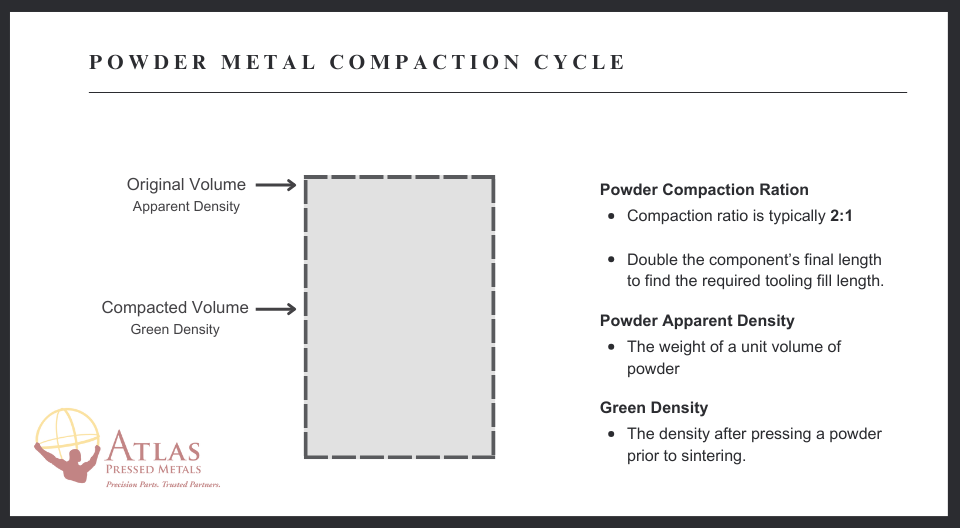
However, the warm die compaction cycle adds a small wrinkle. This process heats the tooling cavity to about 220°F (104°C) before pressing the powder.
By altering the material blend, binders, lubricants, and heat, you can:
- Minimize friction between powder and die
- Improve powder flow
- Increase deformation under pressure
- Retain a more accurate shape after compaction
These improvements help the powder fill the die more effectively, contributing to higher powder metal density and improved mechanical properties.
Sinter to Bond the Particles
During the sintering process, powder particles bond to one another. The particles don’t actually reach a melting temperature, but rather “neck” to one another at elevated temperatures.
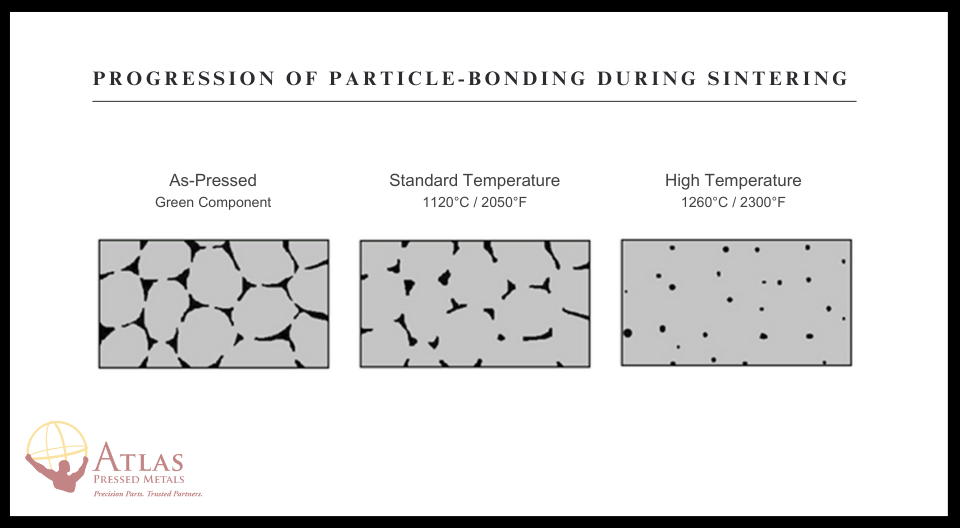 (The progression of particle bonding, including necking, during sintering)
How well the particles bond to each other during sintering depends on the temperature and the amount of time at that heat. Higher temperatures and longer sintering time mean the particles will form larger necks.
A conventional sintering furnace is capable of reaching 2150˚F (1175°C). The properties of most standard powdered materials listed by organizations like MPIF and ASTM are primarily based on a conventional sinter of 2050°F (1120°C) for iron-based materials.
High-Temperature Sintering
Powder metallurgy manufacturers with “high-temp” sintering furnaces have achieved up to 8% increases in density. With these specialized furnaces, sintering atmospheres can operate at temperatures of 2300°F (1260˚C) and beyond. This thermal process:
- Reduces porosity
- Boosts tensile strength
- Improves fatigue strength
The right-most image in the diagram above shows the increased particle bonding of high-temp sintering vs. standard sintering.
You’ll need to balance your performance needs vs. the extra cost – sintering is often the most expensive part of the powder metallurgy process. Adding a few hundred degrees certainly adds to the cost, but it may absolutely be worth it.
Copper Infiltration
Copper infiltration can yield densities to approximately 93% (7.3 g/cm3) while increasing strength.
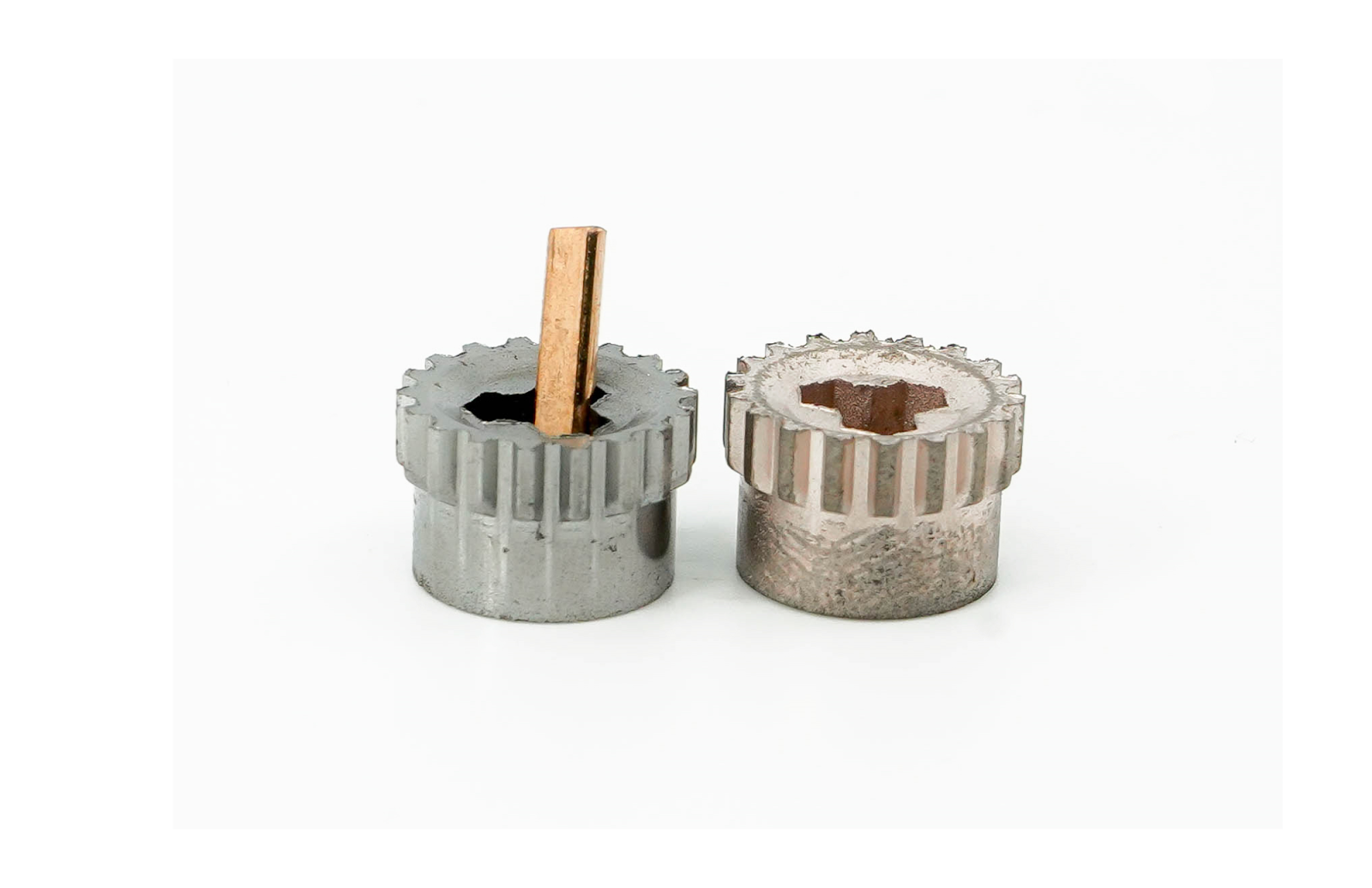
In this process, a predetermined amount of copper is assembled onto a compacted component prior to sintering. During the sintering operation, the copper melts and infiltrates the component’s pores.
It’s a great process, but its popularity is declining because of the eye-popping price of copper. The required assembly also adds to the operation’s cost. Similar density results are usually achievable by other means.
Sizing / Double-Press-Double-Sinter
Sizing, also called restriking, is a secondary operation that involves an extra pressing of a sintered part to ensure a precise size. This process’s main role is post-sinter dimensional control, but your manufacturer can also use it to increase density.
Similar to sizing, double-press-double-sinter takes a pre-sintered component and strikes it again. The difference is the addition of another round of sintering to reach the part’s final characteristics.
Getting the Right Powder Metal Density
Powder metal density can be tailored to meet the performance requirements of a wide range of applications. When density is considered early, engineers have more flexibility throughout the design process.
The final density is influenced by the decisions made before and during manufacturing. Those choices shape how the finished component performs in service.
Working with an experienced powder metal manufacturer helps identify the right approach for your application and production goals.
Need Help Optimizing Powder Metal Density?
Every application has different performance requirements. Our engineering team can help evaluate your design and recommend a powder metallurgy solution that aligns with your goals

(This article originally published in January 2024 and was recently updated to reflect current industry standards.)
COMMENTS